Citrus x clementina
Clementina Clemenules
Harvest: November – January. Table.
Datasheet
No certification yet. We say so rather than leave it out.
Where it grows
- Planted 2001
Masías, Moncada
l'Horta Nord
Plot photographs are still being taken. Ask the grower which origin details we can confirm in writing for your order.
Harvest
Regional picking window: November – January.
Pick when the fruit is ready, not just when the calendar says so. Check the balance of sugars and acidity, juice content and rind condition against the intended use. Rind colour alone does not establish maturity.
Clemenules has a short picking window. Delaying the harvest can cause the rind to separate from the flesh, so confirm the fruit's condition before moving a delivery to a later week.
Work backwards from the delivery week, allowing for packing and transport. The window is a regional reference; the picking date and availability of our fruit are confirmed with the grower before an order.
A clementine in a catalogue of oranges
Clemenules is Citrus x clementina, and on this site it sits beside three Navel oranges. Keep it separate when you write an enquiry. The size codes for clementines under the citrus marketing standard are not the codes used for oranges, so the same figure on a line of your order stands for a different diameter depending on which product that line refers to.
The same separation applies to juice content. The minimum the marketing standard sets for oranges does not cover a clementine, which is why that row is absent from the datasheet above. A specification written for oranges and copied across to this product carries requirements that do not belong to it, and it can leave out the ones that do.
What the fruit is like in the hand
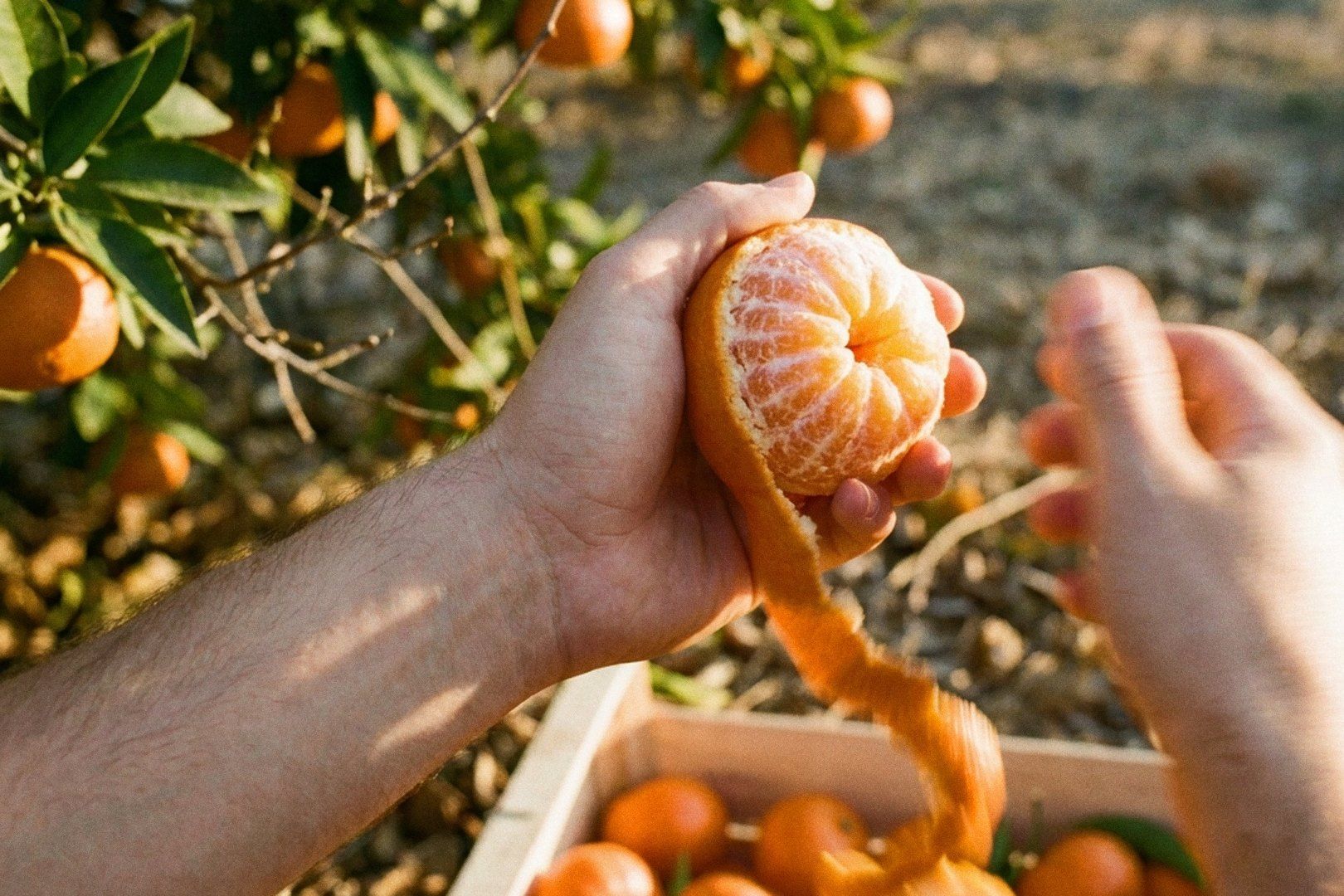
The published descriptions give an oblate fruit, wider than it is tall, at around half the weight of a Navelina. The rind is markedly thinner than a Navel's, smooth and glossy, finely granulated by the oil glands. There is no navel at the apex, which is depressed and at most carries a small stylar scar. The leaf is narrow and lanceolate, which is the clementine leaf rather than the orange tree's.
It peels by hand, and the datasheet lists it for table use alone, where two of our oranges also carry juice. Read it as a single line for a specific job: fruit sold loose and by the piece, to be eaten out of hand. If you are building a mixed citrus enquiry, compare it against the orange pages rather than folding it into them.
A short window, and a harvest that will not wait
This is the shortest picking window of the four, and it closes in the middle of winter, well before the Navels finish. It does not reach the later delivery weeks of the season at all. If clementines belong to a programme that runs on towards spring, the rest of it has to be covered by another product or another supplier, and the availability page is where to start that conversation.
The fruit also puffs if picking is delayed, which UC Riverside notes for this cultivar. A late delivery week is therefore a question for the grower and not something to carry over from the Navels. Ask which weeks can actually be confirmed for the quantity you want, and agree in advance what happens if your customer moves the date.
Price reference, packing and what is still open
The weekly price series we publish does not separate Clemenules. The reference for it is the broader clementine series, so it describes a group rather than this cultivar. The published series for this fruit is the clementine group as a whole, not this cultivar, so it tells you where the category is heading and not what a Clemenules is worth. Treat it as the floor of a conversation, not as a quotation. A group average can move for reasons that have nothing to do with the lot in front of you.
Because the rind is so much thinner than a Navel's, the packing and the route deserve a conversation of their own: ask how the fruit will be packed for your destination and what the pallet should look like on arrival. The row that matters most here is the post-harvest treatment, which is the one thing that decides whether a thin skin survives a long lorry, and it is still unconfirmed on our fruit.
Talk to the grower
Tell us the variety, the sizes and the delivery week you need. You get a delivered price and what we can commit to in writing, from the person who picks the fruit.
The grower handles enquiries. Response times are still to be confirmed.